Portfolio
Research Portfolio
Publications
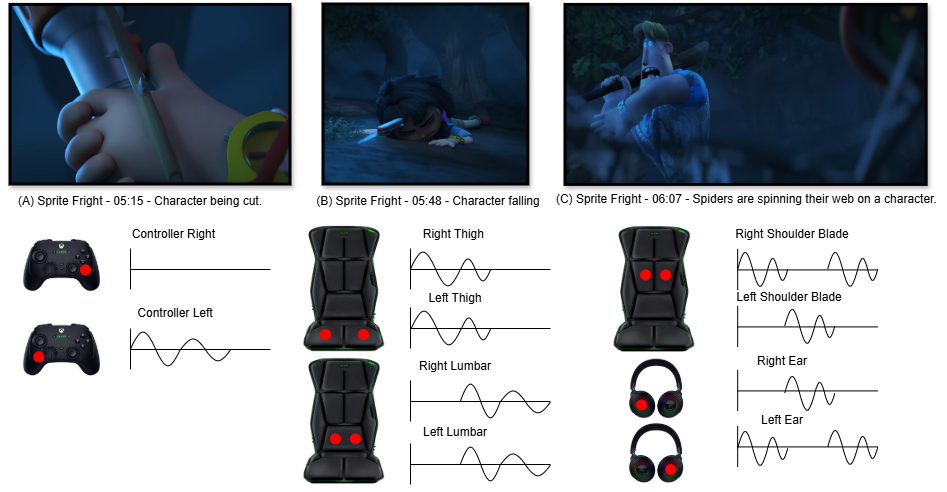
📰 Beyond Audio-to-Haptic: A Comparative User Study of Vibrotactile Design Strategies for Cinematic Experiences
| Seamless, Inria, Univ. Rennes, France & Lab-STICC CNRS UMR 6285, Univ. Brest, France | 2026 | DOI |
| Yann Glémarec, Tom Roy, Quentin Galvan, Gurvan Lécuyer, Ferran Argelaguet | EuroHaptics (July 2026) |
Abstract
The design of vibrotactile content remains less standardized than that of audio or video, and the impact of different rendering strategies on haptic user experience is still not well understood. In this work, we investigate the relevance of the haptic user experience concept for comparing vibrotactile rendering strategies in a passive movie-viewing context. We compare several vibrotactile rendering approaches applied to the same animated short movie. While all the methods evaluated are audio-driven rendering methods they differ in their degree of signal customization across actuators, body locations and feedback spatialization. To evaluate their perceptual impact, we conducted a user study in which participants experienced multiple vibrotactile versions of the same movie sequence. Haptic experience was assessed using the HXI questionnaire. Our results show that direct audio-to-haptic methods and frequency bands approach alone provide a poor haptic experience. Overall, this work demonstrates that design methods based solely on audio-driven rendering, even when adapted to specific hardware constraints, are insufficient to produce a high-quality haptic user experience. Our approach, relying on body-part-specific rendering strategies along with diegetic and non-diegetic effects, appears promising but requires further investigation to establish an optimal design pipeline and to better understand their impact on user perception.
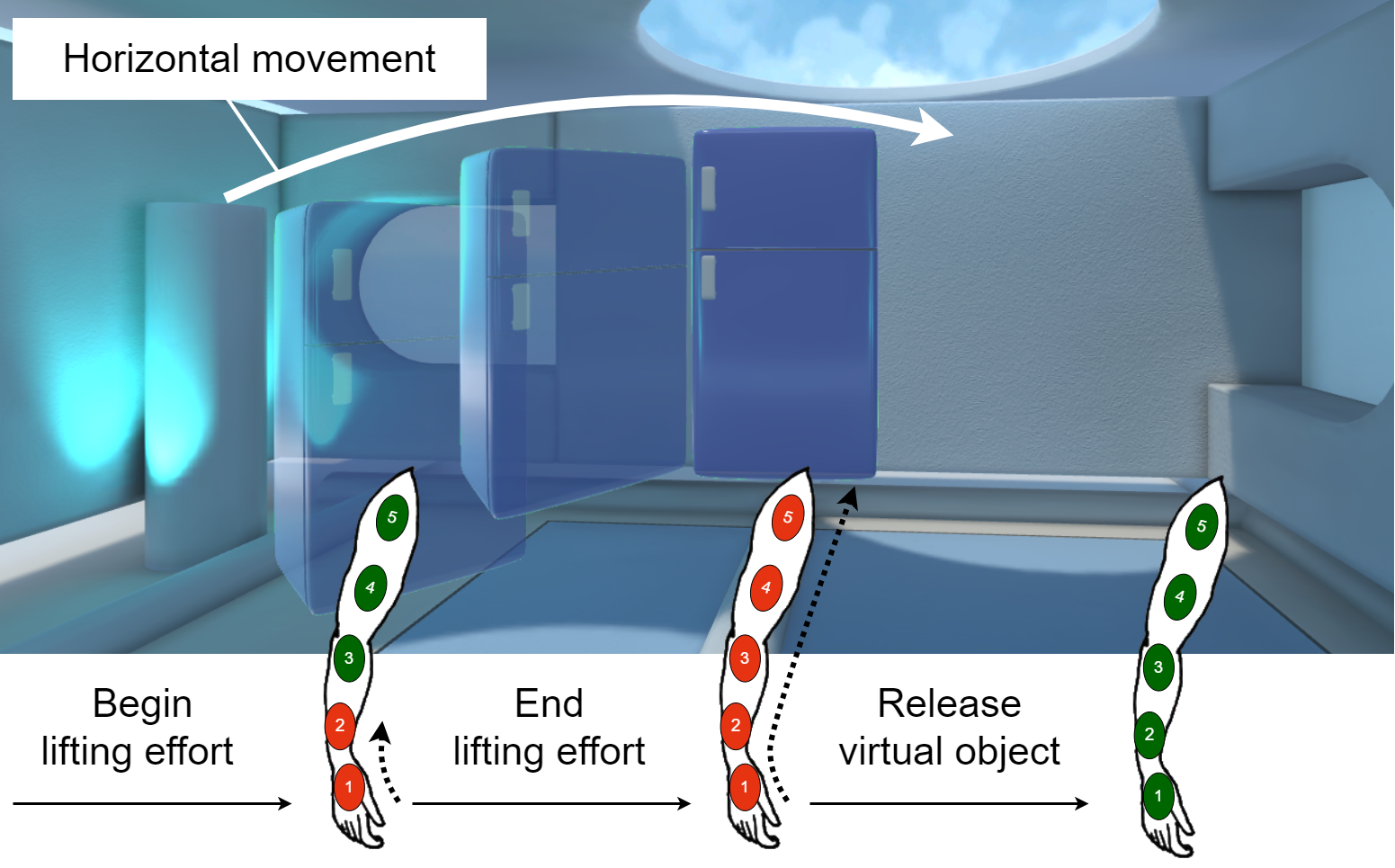
📰 Modulating Effort Sensation in virtual reality: A Parameter-Based Haptic Feedback Approach
| Seamless, Inria, Univ. Rennes, France | 2026 | DOI |
| Yann Glémarec, Tom Roy, Quentin Galvan, Gurvan Lécuyer, Ferran Argelaguet, Anatole Lécuyer | TVCG |
Abstract
Virtual reality is becoming increasingly popular, and modern haptic equipment, such as vibrotactile suits, haptic gloves, and force-feedback controllers, offers new means of interaction within virtual environments, significantly enhancing user experience. When interacting with virtual objects, combined visual and haptic feedback simulates the physical sensations of grasping, lifting, or moving real objects. This sensorimotor feedback is essential for inducing a sense of presence and agency, yet it remains challenging to reproduce in the absence of reliable haptic cues. In this study, we design and evaluate several haptic metaphors using combinations of vibrotactile design parameters to simulate the lifting effort associated with light to heavy objects. These parameters include primitive signals, intensity, spatial density, propagation, and temporal density. Our contribution is threefold. First, we propose a method for modulating perceived physical effort by extending signal intensity with spatial and temporal density, which together reflect the effort required to lift an object. Second, we present a user study in which participants compared haptic effects and ranked them according to perceived lifting effort, comfort, and confidence, allowing us to assess the influence of each parameter. Third, we report the results of a second study in which participants evaluated vibrotactile effects when lifting different virtual objects. The findings confirm the importance of intensity and spatial density, as well as the influence of graphical representation on perceived effort. This research provides practical insights for designing haptic-enabled virtual reality systems and offers guidance for developers seeking to create more expressive and believable vibrotactile interactions.
📄 Towards Virtual Audience Simulation For Speech Therapy
| HCI Group, University of Würzburg (Germany) & Lab-STICC, ENIB (France) | 2022 | DOI |
| Yann Glémarec, Jean-Luc Lugrin, Amelie Hörman, Cédric Buche, Norina Lauer, Marc Erich Latoschik | IVA’23 |
Details
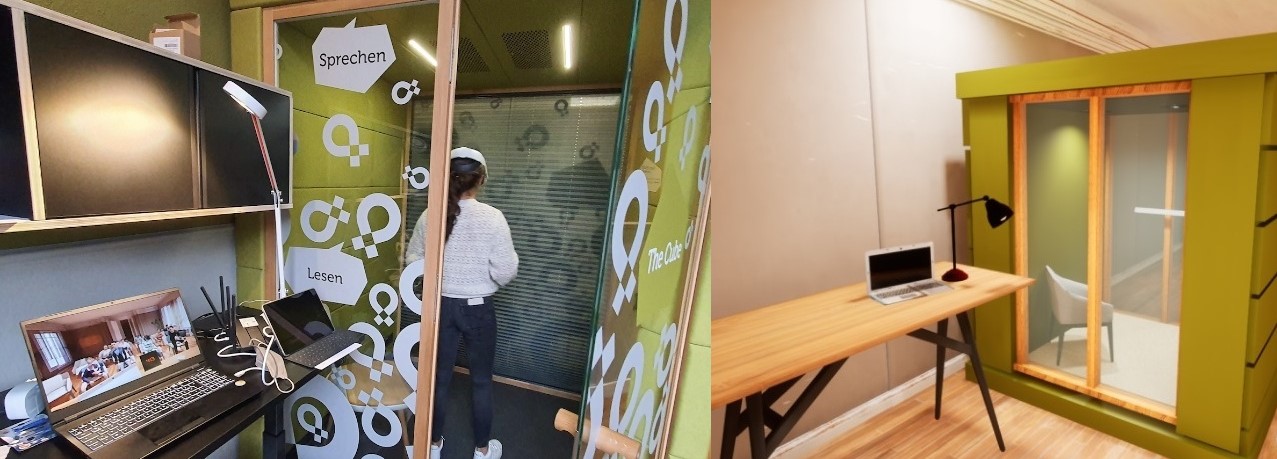
This project served as a proof of concept for the use of our virtual audience simulation system in virtual reality for exposure therapy. In collaboration with Prof. Norina Lauer and her student, Amelie Hörman, we conducted a preliminary user study to evaluate its potential application at the Logopädie Plus Praxis. The study identified key features relevant to exposure therapy, as well as limitations that, according to patients, mainly reduced the believability of the simulation. From the therapists’ perspective, we primarily evaluated the acceptability and usability of both the system and the web-based application developed to supervise the simulation, that is, to control the therapeutic scenario.
📝 Abstract
Virtual reality (VR) technology has shown promise in various therapeutic applications, particularly in exposure therapy for reducing fear of certain objects or activities, e.g., fear of heights or negative evaluation of others in social situations. VR has been shown to yield positive outcomes in follow-up studies and provides a safe and ecological therapeutic environment for therapists and their patients. This paper presents a collaborative effort to develop a VR speech therapy system that simulates a virtual audience for users to practice their public speaking skills. We describe a novel web-based graphical user interface that enables therapists to manage the therapy session using a simple timeline. Lastly, we present the results from a qualitative study with therapists and teachers with functional dysphonia, highlighting the potential of such an application to support and augment the therapists’ work and the remaining challenges regarding the design of natural interactions, agent behaviors, and scenario customization for patients.
📰 Controlling the Stage: A High-Level Control System for Virtual Audiences in Virtual Reality
| HCI Group, University of Würzburg (Germany) & Lab-STICC, ENIB (France) | 2022 | DOI |
| Yann Glémarec, Jean-Luc Lugrin, Anne-Gwenn Bosser, Cédric Buche, Marc Erich Latoschik | Front. In VR |
Details
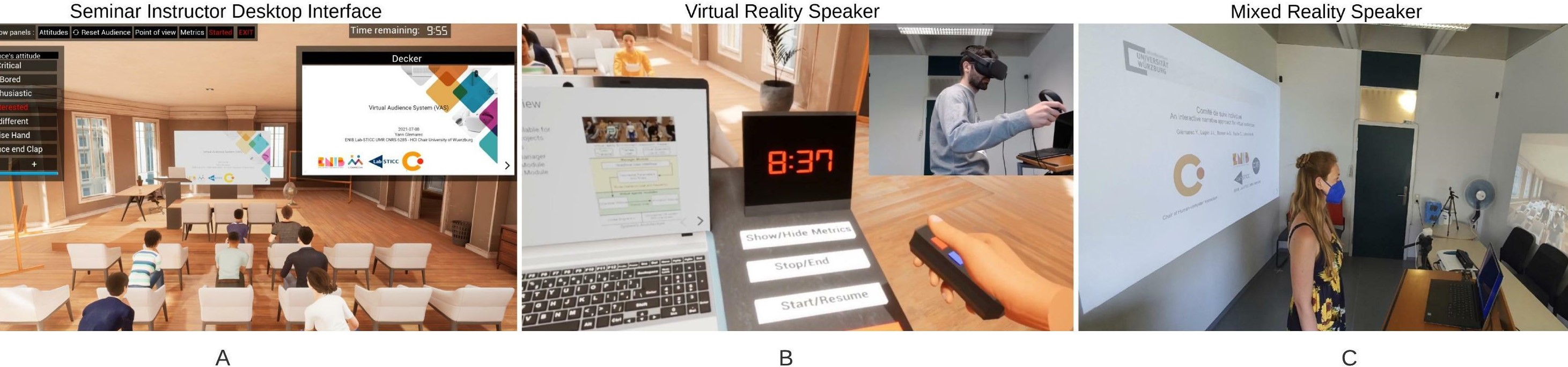
This paper introduces a large project in which we designed an educative application to let students practice their oral exams during covid. It is composed of a virtual reality application that let students use their slides using Decker, a markdown slide tool developped in Würzburg, and a supervisor decktop application to monitor the virtual audience behaviour which listen to the presentation and to the student’s presentation as well. It also includes various features, such as automatic feedback to analyse the student’s behaviour, a REST API to control the system from a simple web browser. This virtual audience’s behaviours is based on a rule based model I design earlier during my thesis that provide non-verbal behaviours (posture, facial expression, head movement, gaze), phatic expressions (e.g., ‘mmhmm’ with a nod while listening) and interactions between agents and the users (e.g., proxemics, scripted events like a character coming late).
📝 Abstract
This article presents a novel method for controlling a virtual audience system (VAS) in a Virtual Reality (VR) application called STAGE, which was initially designed for supervised public speaking training in university seminars dedicated to preparing and delivering scientific talks. We are interested in creating pedagogical narratives: narratives encompass affective phenomena, and rather than organizing events changing the course of a training scenario, pedagogical plans using our system focus on organizing the affects it arouses for the trainees. Efficiently controlling a virtual audience towards a specific training objective while evaluating the speaker’s performance presents a challenge for a seminar instructor: the high level of cognitive and physical demands required to be able to control the virtual audience whilst evaluating the speaker’s performance, adjusting and allowing it to react to the user’s behaviors and interactions quickly. A critical limitation of a number of existing systems is that they rely on a Wizard of Oz approach, where the tutor drives the audience in reaction to the user’s performance. We address this problem by integrating with a VAS a high-level control component for tutors, which allows for using predefined audience behavior rules, defining custom ones, as well as intervening during run-time for finer control of the unfolding of the pedagogical plan. At its core, this component offers a tool to program, select, modify, and monitor interactive training narratives using a high-level representation. The STAGE offers the following features: i) a high-level API to program pedagogical narratives focusing on a specific public speaking situation and training objectives, ii) an interactive visualization interface, iii) computation and visualization of user metrics, iv) a semi-autonomous virtual audience composed of virtual spectators with automatic reactions to the speaker and surrounding spectators while following the pedagogical plan V) and the possibility for the instructor to embody a virtual spectator to ask questions or guide the speaker from within the Virtual Environment. We present here the design and implementation of the tutoring system and its integration in STAGE and discuss its reception by end-users.
Research projects
MAVIS
Mise en scène d’agents virtuels crédibles pour l’évaluation expérimentale de la compréhension des interactions sociales.
🇫🇷 – Les objectifs du projet inter-instituts brestois MAVIS sont de moderniser un outil psychométrique et de l’adapter à des études plus contemporaines sur les interactions sociales, en se basant sur des technologies immersives et adaptatives.
🇬🇧 – The objectives of the inter-instituts brestois MAVIS project are to modernize a psychometric tool and adapt it to more contemporary research on social interactions, using immersive and adaptive technologies.
CONSONENCE
Modélisation d’agents sociaux intelligents et interactions multimodales pour des expériences immersives.
The CONSONENCE project aims to study collaboration between users and virtual agents within heterogeneous immersive environments populated by agents endowed with social interaction capabilities. More specifically, it focuses on the task of listening to narrative content (podcasts, streaming media, oral storytelling, or immersive stereoscopic videos) in a virtual space where embodied agents sustain narrative tension and encourage user interaction with the environment. Such a task, when performed in mixed reality (MR), raises significant scientific and technical challenges: users are physically distant, rely on diverse MR devices (CAVE systems, VR/AR headsets, tablets, screens), and consequently lose access to natural communication channels. This heterogeneity hinders collaboration and collective creativity [1], ultimately degrading user experience quality, engagement, and the emergence of spontaneous interactions.
SAM
Page en construction / Work in progress 🚧
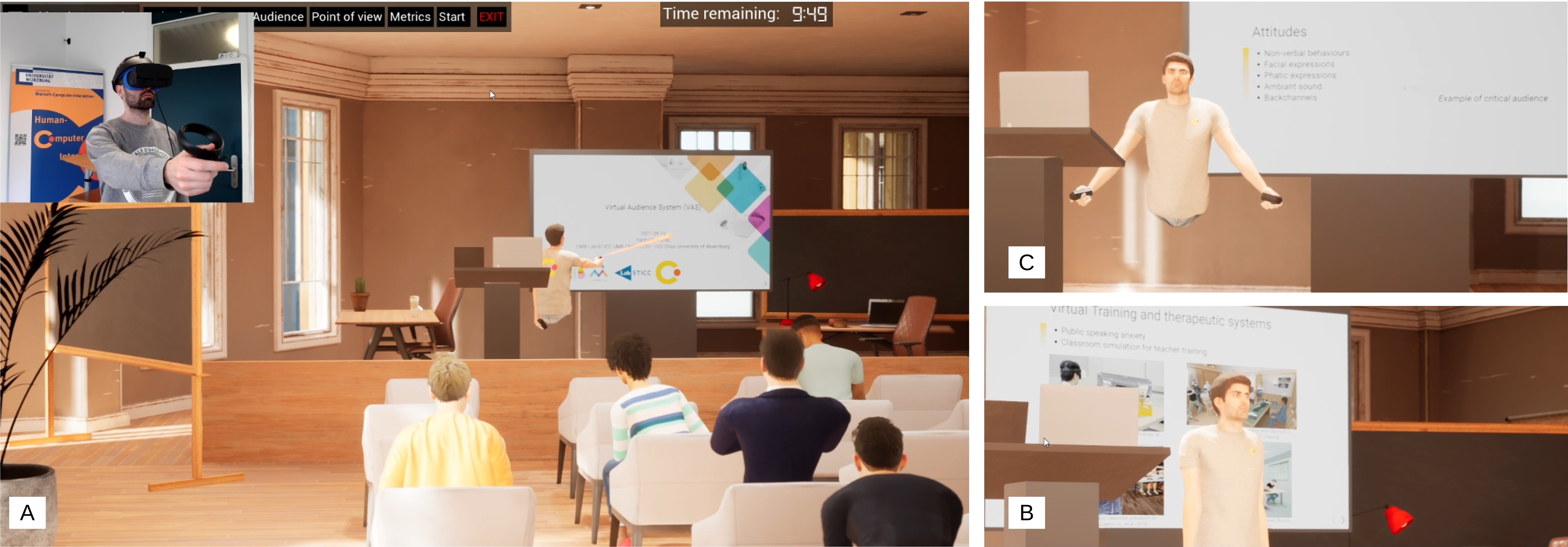
📓 Thesis: Audience simulation and perception in virtual reality.
| HCI Group, University of Würzburg (Germany) & Lab-STICC, ENIB (France) | 2023 | HAL |
📝 Abstract
Many training or exposure therapy applications simulate audiences in virtual reality (VR) to provide safe and ecological environments. However, audience simulation in VR presents many challenges related to creating attitudes from the agents’ non-verbal behaviour. Furthermore, in VR, the animations and the realism of the characters, also called agents, can also create performance problems. The behaviour models used in these systems are not directly evaluated in VR and rely on online studies or the application domain experts’ knowledge. Thus, the difference in technology and the subjectivity of user perception could influence evaluation results. Therefore, we propose an audience behaviour model evaluated in VR that generates the non-verbal behaviours of its members from a given attitude to improve the audiences’ quality and facilitate their use in educational and therapeutic scenarios. We present a series of performance and user perception evaluations in VR aiming at validating the system’s ability to simulate different types of attitudes (bored, interested, or critical) while preserving an optimal VR experience and providing a high-level control application facilitating seamless attitude change in real-time, notably for the creation of training scenarios. Finally, we validate the deployment feasibility of this model in training and exposure therapy applications used by professionals.